
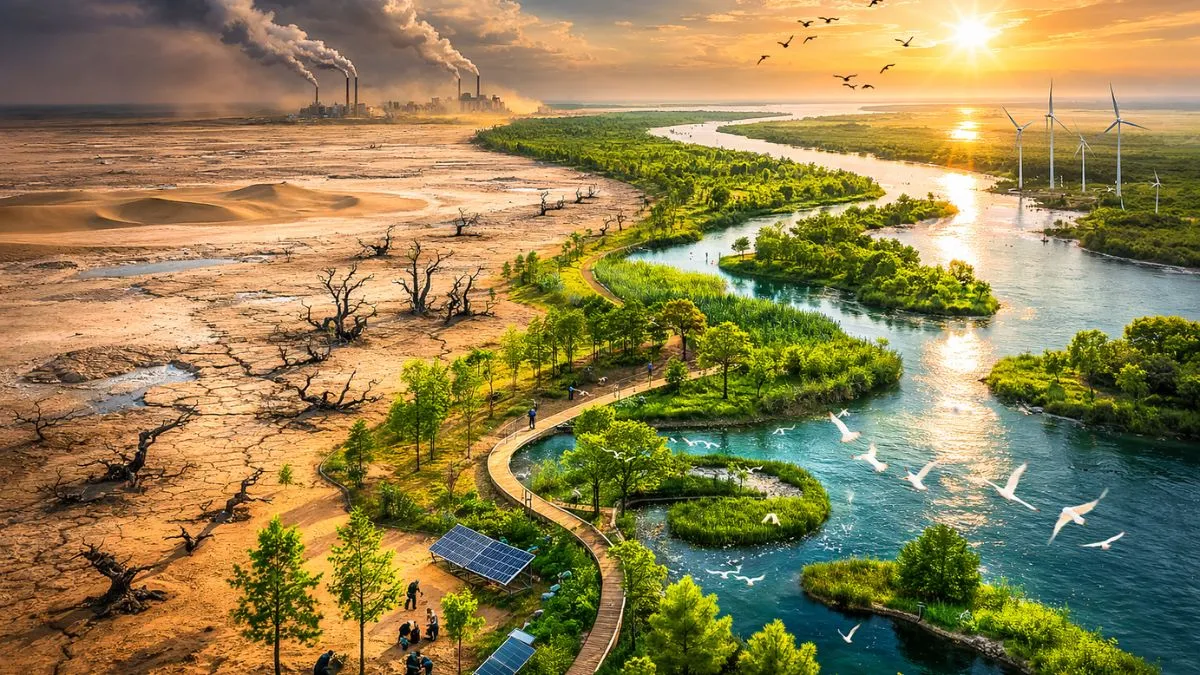
Sea of Death: The dramatic transformation of the Taklamakan Desert stands as one of the world’s most ambitious environmental restoration projects. Once infamous for its lifeless dunes and extreme conditions, this vast desert is now home to expanding green corridors that actively absorb carbon dioxide from the atmosphere.
Previously known as the “Sea of Death,” the region was dominated by relentless winds, moving sand, and near-zero vegetation. Today, visitors are greeted by tree canopies, birdsong, and stabilized landscapes—evidence of how strategic afforestation can reshape even the harshest environments.
Beyond regional benefits, the greening of the Taklamakan plays a meaningful role in global climate mitigation by functioning as a large-scale natural carbon sink.
From Barren Wasteland to Living Landscape
Spanning more than 130,000 square miles, the Taklamakan is one of the largest shifting-sand deserts on Earth, located in Xinjiang Uyghur Autonomous Region. For centuries, its extreme heat, scarce rainfall, and unstable dunes made sustained life nearly impossible.
In the late 1970s, the Chinese government acknowledged the escalating risks of desertification—ranging from dust storms to agricultural losses—and initiated a long-term afforestation strategy. Billions of dollars were invested, and thousands of workers, scientists, and engineers were mobilized to bring vegetation back to the desert.
The mission required innovation: water-saving irrigation systems, sand-fixing techniques, and the careful selection of tree species capable of surviving intense drought, salinity, and temperature extremes.
The Ecological Science Driving the Greening Effort
The success of the Taklamakan project lies in its ecosystem-based design. Instead of planting a single species, planners introduced a mix of hardy plants that support one another while reshaping local environmental conditions.
Key Tree Species and Their Environmental Roles
| Tree Species | Ecological Contribution |
|---|---|
| Poplar | Rapid growth, strong drought tolerance, and effective sand-dune stabilization |
| Elaeagnus angustifolia | Improves soil fertility through nitrogen fixation and supports wildlife |
| Haloxylon ammodendron | Withstands extreme heat and minimal rainfall; ideal for desert survival |
Together, these species improve soil structure, reduce wind erosion, retain moisture, and gradually influence micro-climates—making the environment increasingly self-sustaining.
Why a Greener Taklamakan Matters to the World?
The newly established forests now capture and store substantial amounts of atmospheric carbon dioxide, directly contributing to climate-change mitigation. As vegetation expands, dust storms have decreased, air quality has improved, and rainfall patterns have become more stable.
Local communities surrounding the desert benefit from cleaner air, better water retention, and new economic opportunities tied to sustainable forestry and eco-tourism.
Environmental experts highlight the Taklamakan as proof that large-scale ecological repair is achievable when science, policy, and long-term commitment align.
Obstacles Faced and Insights Gained
Transforming one of the planet’s most hostile deserts was far from easy. Limited water supplies, logistical difficulties, and skepticism from critics challenged the project at every stage.
Many doubted whether trees could survive long-term in such conditions. However, decades of consistent investment, adaptive management, and scientific monitoring demonstrated that restoration is possible—even in extreme landscapes.
Key lessons include:
- The importance of diversified ecosystems over monoculture planting
- The necessity of long-term planning rather than short-term fixes
- The value of combining technology with ecological knowledge
What Lies Ahead for the Taklamakan Desert?
China has committed to further expanding the desert’s green belt, with plans to afforest an additional 66.7 million acres. The goals extend beyond carbon absorption to include stronger biodiversity, improved ecological resilience, and enhanced livelihoods for nearby populations.
The project also serves as a global reference model, offering transferable knowledge for other countries facing desertification and land degradation.
A Blueprint for Climate-Resilient Restoration
The revival of the Taklamakan Desert proves that even the most unforgiving environments can be restored through perseverance, science, and respect for natural systems. What was once a symbol of desolation is now a functioning carbon sink and a beacon of environmental possibility.
As climate change accelerates worldwide, the Taklamakan’s transformation offers more than hope—it provides a practical roadmap for restoring degraded landscapes and building a sustainable future.
FAQs
What is the Taklamakan Desert?
The Taklamakan Desert is a massive shifting-sand desert in northwest China’s Xinjiang region, covering over 130,000 square miles.
How did China green the Taklamakan Desert?
Through a decades-long afforestation program using drought-resistant trees, advanced irrigation, and sand-stabilization techniques.
What environmental benefits resulted from this transformation?
Carbon sequestration, reduced dust storms, improved rainfall, healthier ecosystems, and better living conditions for nearby communities.