
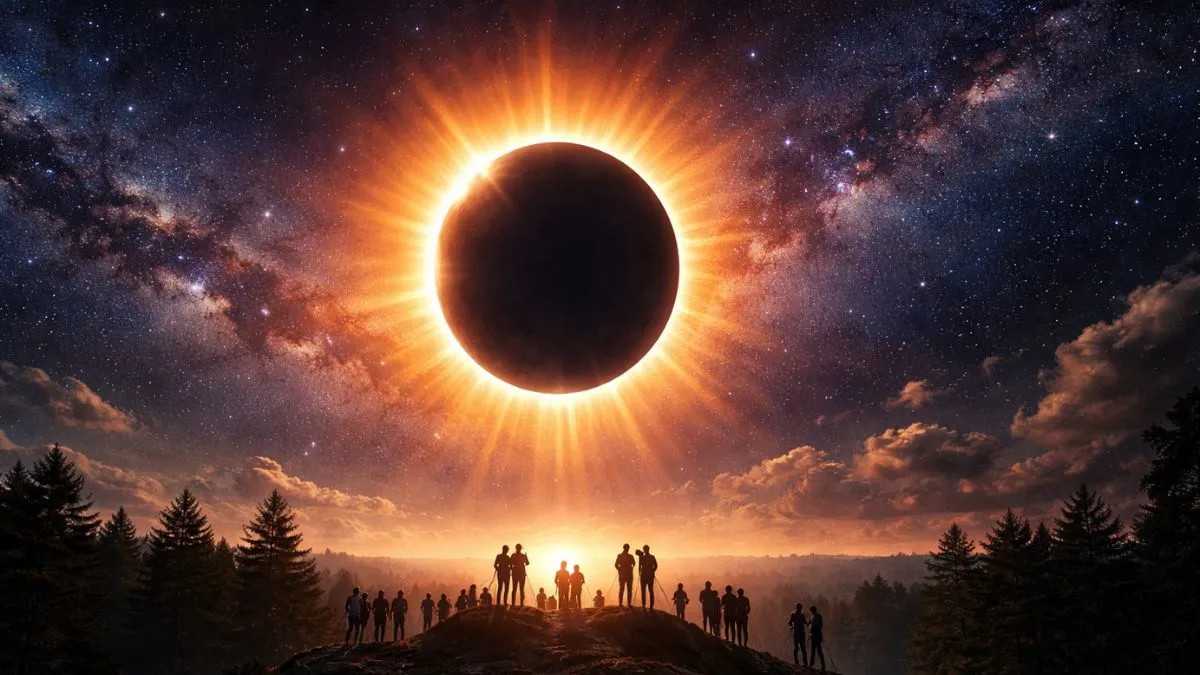
Eclipse Of The Century: Imagine an ordinary afternoon slowly slipping into silence. The bright sky begins to dim, temperatures subtly drop, birds fall quiet, and sharp, surreal shadows stretch across the ground. Within moments, daylight gives way to an otherworldly twilight.
This dramatic sequence marks the beginning of what astronomers are calling the eclipse of the century—a rare celestial spectacle delivering almost six uninterrupted minutes of total darkness.
During this extraordinary event, regions lying within the path of totality will witness the Moon completely covering the Sun. As sunlight disappears, the Sun’s glowing outer atmosphere—the solar corona—emerges in a breathtaking display.
More than just a visual phenomenon, this total solar eclipse is often described as a deeply emotional experience, blending scientific wonder with a sense of cosmic humility that leaves a lasting impression on viewers.
What Makes This Total Solar Eclipse the Highlight of the 21st Century?
Several factors set this eclipse apart from all others in modern times. First is its exceptional duration. While most total solar eclipses last only two to three minutes, this one offers close to six minutes of complete darkness—a rarity caused by a precise alignment between the Sun, Moon, and Earth.
Second, the clarity of the solar corona during such a long totality allows scientists and observers to study fine details that are usually hidden. From plasma streams to magnetic structures, the extended darkness creates a perfect natural laboratory for solar research.
Finally, accessibility plays a major role. The path of totality crosses multiple populated regions, giving millions of people the chance to experience a phenomenon many will only see once in their lifetime. Events like the Total solar eclipse of 2 August 2027 are expected to draw global attention from scientists, travellers, and skywatchers alike.
Why This Eclipse Is More Than Just a Sky Event
Total solar eclipses have a unique ability to unite people. For a few minutes, daily routines pause as everyone looks upward together.
Scientists gain valuable data, photographers capture once-in-a-lifetime images, and first-time viewers often describe an overwhelming sense of awe. It’s a reminder of our planet’s place in the vast universe—and of how rare and precise such cosmic alignments truly are.
A Once-in-a-Century Celestial Experience That Redefines Day and NightConclusion
The eclipse of the century is not simply about darkness in the daytime—it’s about perspective. Nearly six minutes without sunlight will offer a powerful blend of beauty, science, and emotion.
Whether you’re an astronomy enthusiast or a casual observer, witnessing this total solar eclipse promises to be a defining moment, one that transforms an ordinary afternoon into an unforgettable encounter with the cosmos.
FAQs
Why is this eclipse called the eclipse of the century?
Because of its unusually long duration of totality and its visibility across populated regions, making it is exceptionally rare.
How long will the total darkness last?
Observers in the path of totality can experience nearly six full minutes of complete darkness.
What will be visible during totality?
The Sun’s corona, along with stars and planets that are usually hidden by daylight, may become visible.