
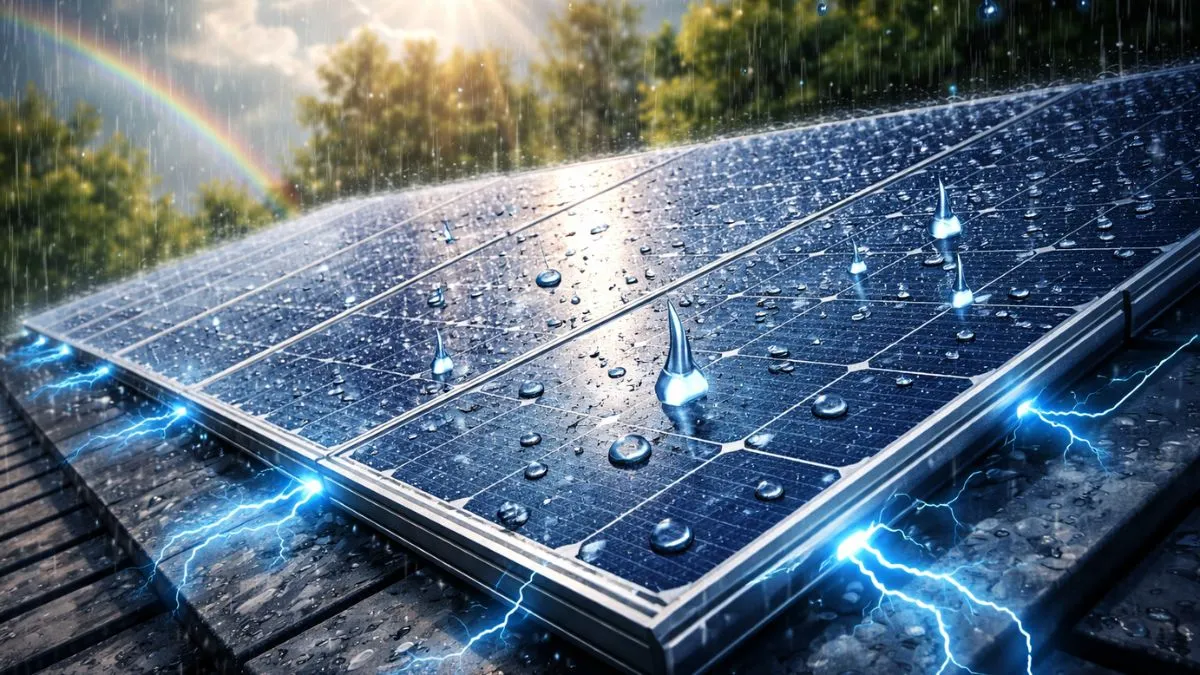
For decades, solar energy systems have relied entirely on sunlight. Whenever dark clouds appear and rain begins to fall, traditional solar panels typically lose much of their power output.
But researchers in Spain are challenging this limitation with an innovative approach that allows solar panels to generate electricity even during rainfall.
A team of scientists based in the Institute of Materials Science of Seville in Seville, Spain, has developed a hybrid solar panel capable of producing electricity from both sunlight and raindrops.
Their patented thin-film technology can reportedly produce voltage spikes of up to 110 volts from the impact of a single raindrop, opening new possibilities for renewable energy systems.
The research was conducted by the Nanotechnology on Surfaces and Plasma Laboratory and published in the scientific journal Nano Energy
A New Way to Capture Energy from Rain
Traditional solar panels stop working efficiently when sunlight disappears behind clouds. Instead of seeing rain as an obstacle, researchers decided to turn it into a source of power.
The newly developed device combines a high-efficiency Perovskite Solar Cell with a specialized ultra-thin protective coating. This coating is only 100 nanometers thick and behaves similarly to Teflon, creating a smooth and water-repellent surface.
When sunlight is available, the solar cell operates normally, converting light into electricity. However, when raindrops fall onto the surface, the panel switches to another mechanism that captures energy from the droplets’ motion.
This dual-function design allows the panel to generate electricity regardless of weather conditions.
How the Triboelectric Effect Generates Electricity?
The rain-powered feature of the panel works through a physical phenomenon known as the Triboelectric Effect.
When a raindrop strikes the panel’s specially treated surface and slides across it, friction occurs between the water and the coating. This interaction causes a small imbalance of electrical charge. For example, the droplet may leave behind positive ions while the surface becomes negatively charged.
This difference in charge creates an electrical potential that can be captured and converted into usable electricity.
Essentially, each falling droplet becomes a tiny generator capable of contributing energy to the system.
The Perovskite Advantage — and Its Biggest Challenge
The core of the device relies on halide perovskites, materials that have rapidly gained popularity in renewable energy research. These materials are cheaper to manufacture than traditional silicon and have achieved remarkable improvements in performance.
In just a few years, perovskite solar cells have improved from less than 4% efficiency to more than 25%, making them one of the most promising alternatives to conventional solar technologies.
However, perovskites have a major weakness: they are extremely sensitive to moisture.
Exposure to humidity can quickly degrade the crystal structure of the material, often turning it into a yellow compound known as lead iodide. This degradation dramatically reduces the panel’s ability to produce electricity.
Because of this vulnerability, rain has long been considered a serious threat to perovskite solar cells
A Protective Layer That Also Produces Power
To solve this problem, researchers created a special protective coating using a process called Plasma Enhanced Chemical Vapour Deposition.
This technique allows the protective layer to be deposited at room temperature and without the use of solvents, preventing damage to the delicate solar cell underneath.
The resulting fluorinated polymer film performs three important roles:
1. Moisture Protection
The coating creates a highly hydrophobic surface, meaning water cannot easily stick to it. The water contact angle increases to about 110 degrees, significantly improving the panel’s resistance to moisture.
2. Improved Sunlight Absorption
The transparent layer reduces surface reflection and allows over 90% of incoming light to pass through. This actually helps the solar cell capture more sunlight than it could without the coating.
3. Raindrop Energy Generation
Finally, the coating acts as a Drop Triboelectric Nanogenerator (D-TENG). When raindrops hit the surface and slide away, friction generates an electrical charge that can be harvested.
Turning Raindrops into Voltage
During laboratory tests, the researchers observed that a single falling droplet could generate voltage peaks of up to 110 volts.
While the overall power output is relatively modest — roughly 4 milliwatts per square centimetre — it is sufficient for small, low-power electronics.
To demonstrate the concept, the scientists built a self-charging prototype that used a voltage-boosting converter. In their experiment:
- Red LEDs were powered continuously by sunlight.
- Green LEDs flashed whenever raindrops struck the panel.
This simple setup showed that the hybrid system could collect energy from both weather conditions simultaneously.
Durability Tests Show Promising Results
The research team also tested the durability of the coated solar cells under harsh environmental conditions.
The encapsulated panels maintained more than 50% of their original efficiency after 10 days of exposure to heat and humidity.
In another extreme test involving direct water immersion, the protected cells continued functioning for over 15 minutes, while unprotected perovskite cells failed almost immediately.
These results suggest that the new coating significantly improves the practical durability of perovskite solar technology.
Potential Applications in Smart Cities and Remote Systems
Although this hybrid technology is not yet intended to replace large rooftop solar installations, it has strong potential for powering small electronic systems.
One of the most promising applications is the rapidly expanding Internet of Things (IoT) network.
Millions of sensors are being deployed in smart cities to monitor traffic, air pollution, structural safety, and environmental conditions. Maintaining these devices often requires replacing batteries, which can be expensive and difficult in remote locations.
Hybrid solar-rain panels could provide a self-sustaining power source for:
- Smart city infrastructure
- Autonomous lighting systems
- Environmental monitoring sensors
- Marine research stations
- Remote agricultural monitoring devices
By harvesting both sunlight and rainfall, these panels can supply small but continuous amounts of energy in locations where wired power is impractical
The hybrid solar panel developed by researchers in Seville represents a creative step forward in renewable energy technology. By combining perovskite solar cells with a triboelectric rain-energy generator, the device transforms rain from a limitation into an additional energy resource.
The ultra-thin protective coating not only shields delicate perovskite materials from moisture but also captures kinetic energy from falling raindrops.
With the ability to generate voltage spikes of up to 110 volts from individual droplets, the system demonstrates an innovative way to harvest environmental energy.
While the technology is still in early stages and not ready to replace traditional solar arrays, it shows strong potential for powering low-energy devices in smart cities, remote infrastructure, and sensor networks.
As renewable energy research continues to evolve, solutions like this hybrid solar-rain panel could help create more resilient and autonomous energy systems for the future.
FAQs
How can a raindrop generate electricity?
When a raindrop hits the coated surface, friction creates an electrical charge difference, producing voltage through the triboelectric effect.
What makes perovskite solar cells special?
They are cheaper to manufacture than silicon panels and have rapidly achieved efficiencies above 25%.
Where could this technology be used?
It could power IoT sensors, smart city devices, remote monitoring stations, and small autonomous electronics.