
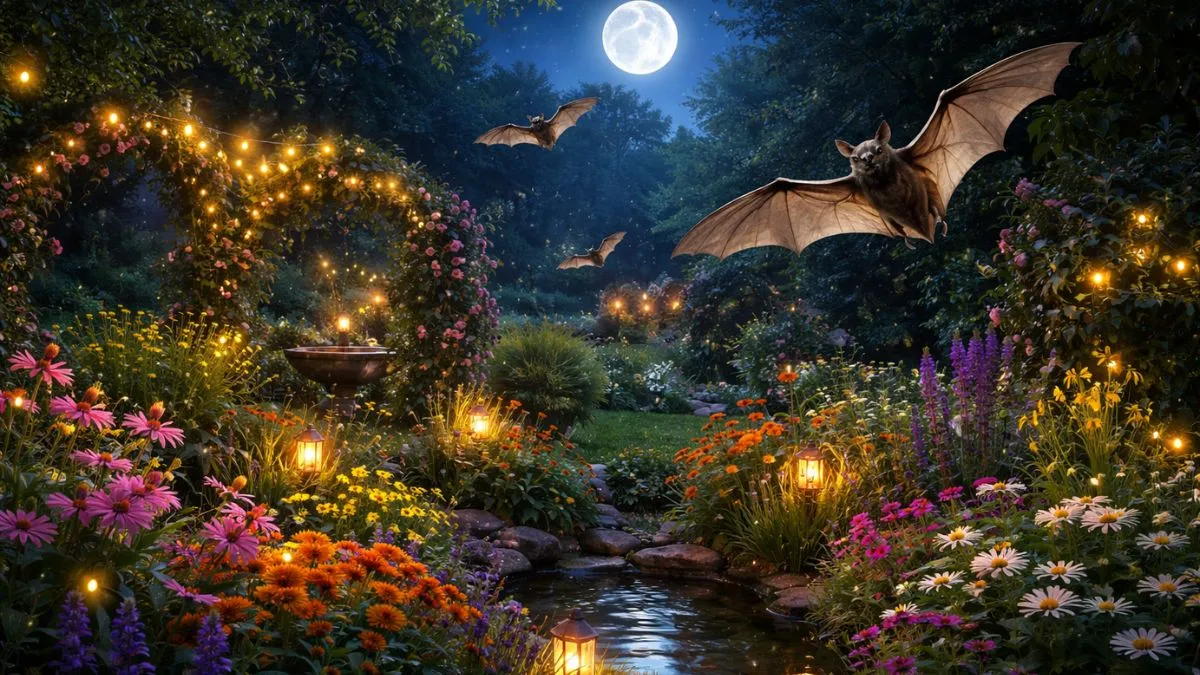
Scientists explain that when bats start circling above gardens and homes after sunset, they are often responding to environmental activity happening below.
Their presence may actually indicate a thriving and balanced backyard ecosystem. Bats are nocturnal mammals, meaning they become active shortly after sunset.
Their sudden appearance around houses and gardens can surprise people because they remain hidden during daylight hours. However, their presence is rarely accidental
Bats Flying Over Your Garden Highlight an Important Ecological Role
As evening approaches and daylight slowly fades, the activity in the sky changes. Birds settle into trees, and the air briefly becomes still. Then, small shadowy figures begin to appear, darting rapidly through the sky above rooftops and gardens.
These quick, zigzagging movements are usually bats emerging for their nightly feeding routine. They move swiftly and silently, often visible for only a moment before changing direction and disappearing back into the darkness.
Bats are nocturnal mammals, meaning they become active shortly after sunset. Their sudden appearance around houses and gardens can surprise people because they remain hidden during daylight hours.
However, their presence is rarely accidental. When bats repeatedly fly over a particular yard, it often reflects something happening within that environment—usually the availability of food.
Bats Capture Insects with Exceptional Accuracy
Most bats commonly seen flying over residential areas are insectivores, meaning their diet consists mainly of flying insects. According to agricultural and wildlife experts, these animals play a valuable role in natural pest management by feeding on insects that gather around vegetation, water features, and outdoor lights.
During a single night, bats can travel several kilometres while searching for food. Even while covering large distances, they often return to locations where insects are especially plentiful.
The insects they feed on include many species commonly found near homes. Mosquitoes, moths, beetles, and other night-flying insects make up a significant portion of their diet. Over the course of several hours, a single bat may consume hundreds of insects.
Scientific studies have shown that bat activity increases in areas where insect populations are dense. When insects gather around flowering plants, garden vegetation, or outdoor lighting, bats tend to spend more time hunting in those locations. This is why gardens rich in plants and water features often attract bats after sunset.
Night Pollinators That Often Go Unnoticed
While many bats are known for eating insects, some species play another important ecological role: pollination.
Certain bats feed on nectar rather than insects. These nectar-feeding bats visit flowers that open only at night. As they drink nectar, pollen sticks to their fur and is carried to the next flower they visit, helping plants reproduce.
Wildlife researchers explain that in several ecosystems, bats act as nighttime pollinators much like bees, butterflies, and birds do during the day.
One well-known example is the agave plant, which depends on bats to transport pollen between flowering stalks. These plants open their blossoms at night and produce nectar that attracts bats travelling long distances during feeding routes.
What the Presence of Bats Reveals About Your Garden?
If bats frequently fly above your yard, it may be a sign that your garden supports a healthy ecological balance.
Gardens with a variety of plants naturally attract insects. Those insects then attract animals that feed on them. This interaction forms part of a broader ecological network connecting plants, insects, and predators.
Scientific research examining bat feeding behaviour shows that bats concentrate their activity in landscapes where insect diversity is high. Areas containing vegetation, flowering plants, and water sources often support larger insect populations, providing reliable hunting grounds.
Residential gardens can create comparable conditions. Features such as flowering plants, fruit trees, ponds, and even outdoor lighting can draw insects after sunset. When insects repeatedly gather in these spots, bats may begin flying overhead regularly as they follow nightly feeding paths.
Why Bats Almost Never Interact with Humans?
Despite widespread myths and fears, bats flying above homes rarely interact directly with people.
Their echolocation system also allows them to avoid obstacles with remarkable precision. By interpreting returning sound waves, bats can detect trees, walls, branches, and even thin wires in the dark.
Across many regions of the world, bats continue this natural routine every evening, flying silently above gardens, forests, and farmland while helping maintain ecological balance.
A Sign of a Healthy Backyard Ecosystem
Seeing bats flying above your garden at night is often a positive indicator rather than something to worry about. Their presence usually means your yard supports a rich environment filled with plants and insects.
By feeding on mosquitoes, moths, beetles, and other pests, bats provide valuable natural pest control. Some species also assist in pollinating plants that bloom after dark, contributing to plant reproduction and biodiversity.
Far from being a nuisance, bats are important allies in maintaining ecological balance. If they regularly visit your garden, it likely means your outdoor space is part of a thriving and interconnected ecosystem that supports wildlife.
FAQs
Why do bats fly around houses at night?
Bats fly around homes because insects gather near plants, water sources, and outdoor lights. These insects provide food for bats.
Are bats beneficial for gardens?
Yes. Bats help control pests by eating mosquitoes, moths, beetles, and other insects that can damage plants.
Do bats pollinate plants?
Some bat species feed on nectar and help pollinate plants that bloom at night, including agave and certain desert flowers.