
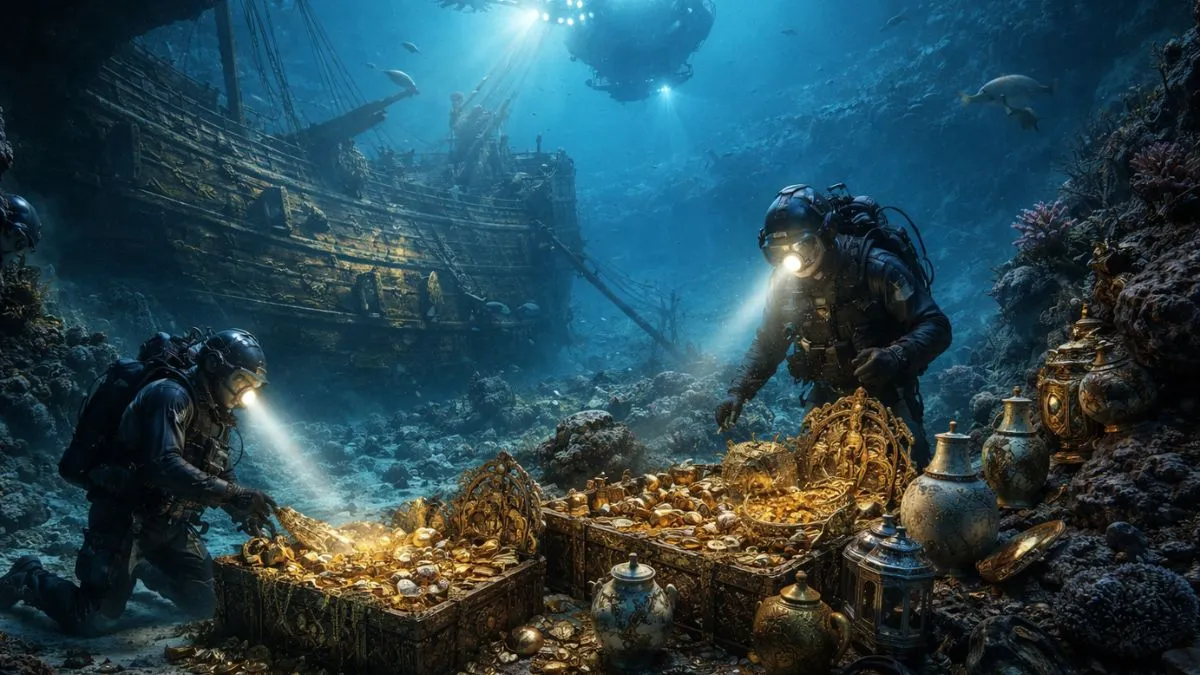
During a routine deep-sea exploration in the South China Sea, researchers made a surprising discovery nearly 1,500 meters below the ocean surface.
What initially appeared to be a collection of pale stones turned out to be something far more significant—carefully arranged porcelain artefacts from a centuries-old shipwreck.
The unexpected find was captured by a deep-sea rover whose camera recorded clusters of rounded objects resting on the seafloor. As the vehicle’s lights brightened the scene, investigators noticed the glossy texture of glazed porcelain pieces stacked in organized layers rather than scattered debris.
Survey Mission Reveals a Rare Deep-Water Shipwreck
The discovery occurred during an underwater heritage survey organized by the National Cultural Heritage Administration (NCHA). The program began documenting historical sites beneath the sea the previous year, focusing on unexplored maritime routes.
The extreme depth of the site made the discovery particularly unusual. Very few shipwrecks from the Ming Dynasty have ever been located at such depths, making the site an important archaeological breakthrough.
A second dive confirmed that the objects were indeed ceramic artefacts. Surprisingly, many pieces appeared remarkably well preserved despite centuries under intense deep-sea pressure. Their condition allowed researchers to identify them as products from some of China’s most famous historic kiln centres.
A Seafloor Field Filled With Preserved Porcelain
As researchers expanded the survey area, they realised the site was much larger than initially believed. The location was officially named Shipwreck No. 1 and was found to contain more than 100,000 artefacts, most of them porcelain.
The objects included bowls, plates, jars, and ceremonial vessels commonly associated with mid-Ming export goods. Many of the pieces were still arranged in cargo stacks, suggesting the ship sank without violently scattering its load.
Experts from the NCHA confirmed that several of the ceramics were produced in the renowned Jingdezhen kilns. For centuries, this region served as a global centre for porcelain manufacturing, producing ceramics exported across Asia and beyond.
Scientists believe the remarkable preservation occurred because of the deep-sea environment. Low temperatures, minimal currents, and limited biological activity helped protect the cargo from damage.
Discovery of a Second Shipwreck With Timber Cargo
Not far from the porcelain site, sonar scans revealed another cluster of objects on the seabed. Unlike the ceramic artefacts, these items appeared long and straight. Further dives confirmed that the materials were large wooden logs arranged in organised rows.
This second location was designated Shipwreck No. 2.
Instead of export ceramics, this vessel appears to have transported timber—likely imported wood used for construction and shipbuilding during the early Ming period.
According to an official NCHA statement, the two shipwrecks represent opposite directions of maritime trade: one carrying goods for export and the other transporting imported resources.
Advanced Technology Used to Study the Sites
Researchers used the advanced deep-sea submersible Fendouzhe to carefully document both wrecks. The vehicle captured detailed high-resolution images and mapped the cargo distribution without disturbing the arrangement of artifacts.
Archaeologist Zhou Wei explained that decorative patterns and shapes on the ceramics provided valuable clues about their age. Many pieces match designs widely produced during the mid-Ming era.
Meanwhile, analysis of the timber cargo at Shipwreck No. 2 showed sizes and stacking methods consistent with historical records describing wood imports from overseas regions.
Evidence of Active Ming-Era Maritime Trade
The combination of export ceramics and imported timber offers a rare snapshot of maritime trade routes during the Ming Dynasty.
Historical documents describe extensive shipping networks across the South China Sea, and the cargo from both wrecks closely matches those records.
Because the artifacts remain largely undisturbed on the seafloor, researchers can study the original cargo layout with exceptional accuracy—something rarely possible with shallow-water shipwrecks where currents and human activity often disturb the remains.
Future Research and Preservation Plans
The NCHA has announced that the sites will continue to be studied using advanced methods such as 3D mapping, remotely operated vehicles, and sediment analysis. These technologies allow archaeologists to document the wrecks while minimizing disturbance.
Experts from the Chinese Academy of Sciences will also participate in the research, helping scientists analyse ocean conditions and the long-term preservation of submerged artefacts.
Both shipwrecks will remain under strict protection as investigations continue.
A Remarkable Deep-Sea Discovery That Reshapes Understanding of Ming-Era Trade
The discovery of two remarkably preserved shipwrecks nearly 1,500 meters beneath the South China Sea provides an extraordinary window into global trade during the Ming Dynasty.
With one vessel carrying exported porcelain and the other transporting imported timber, the sites illustrate the scale and complexity of maritime commerce centuries ago.
As researchers continue mapping and studying the cargo fields, these underwater time capsules are expected to reveal even more about ancient trade networks, shipbuilding practices, and cultural exchange across Asia.
FAQs
How deep was the Ming Dynasty shipwreck discovered?
The shipwreck was found nearly 1,500 meters below the surface of the South China Sea, making it one of the deepest Ming-era archaeological discoveries.
What artefacts were discovered at the shipwreck site?
Archaeologists uncovered more than 100,000 porcelain items, including bowls, dishes, jars, and ceremonial vessels, believed to be export cargo.
Where were the porcelain artefacts originally produced?
Many of the ceramics were traced back to Jingdezhen, a historic Chinese city famous for producing high-quality porcelain during the Ming Dynasty.