
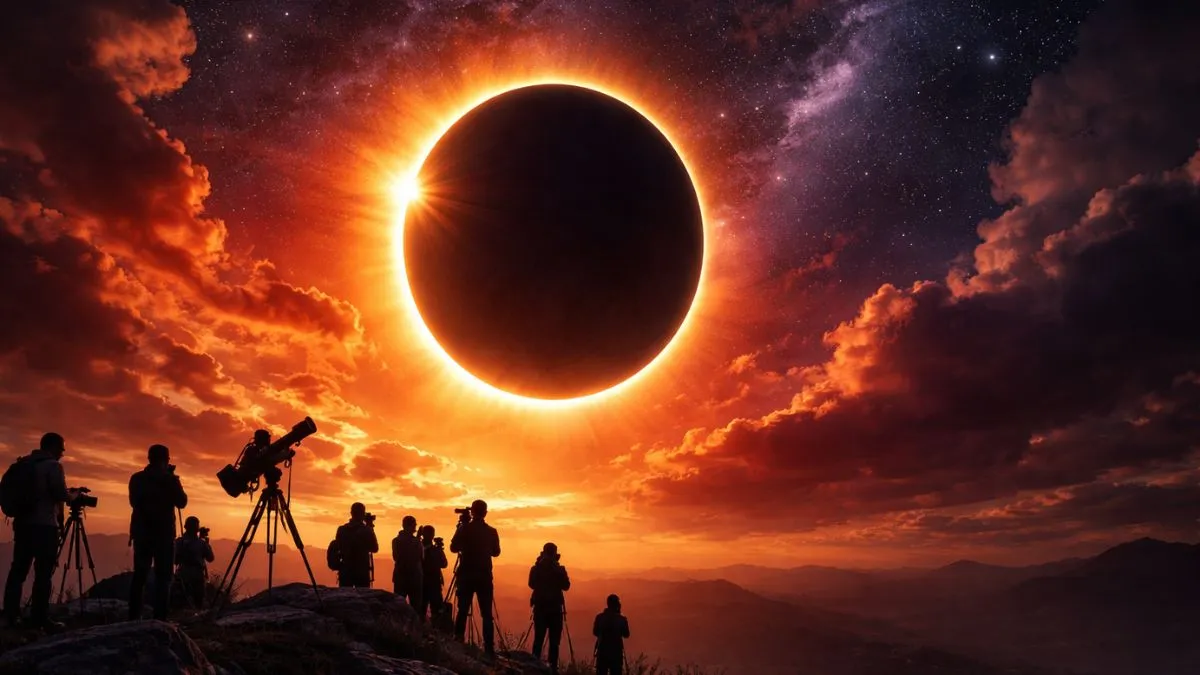
Solar Eclipse: Picture a normal weekday afternoon. Clothes sway on balconies, children play below, and someone waters plants under a bright sky. Everything feels routine—until it isn’t.
Without warning, the sunlight starts to shift. Shadows stretch and blur. The air cools. Birds stop singing. People pause, step outside, and glance upward, unsure why the world suddenly feels different.
Astronomers say that on one precisely calculated day in the near future, this surreal scene will unfold across vast parts of the globe during the Longest Solar Eclipse of the century.
Day will turn into night—and remain dark longer than any solar eclipse witnessed by people alive today.
The Date Scientists Have Officially Locked In
Astronomy observatories around the world have confirmed the timing of what will be the longest total solar eclipse of the 21st century. This will not be a brief flash of darkness—it will be a prolonged celestial blackout.
In certain regions along the eclipse’s path, totality will last more than seven minutes, an extraordinary duration by eclipse standards. On paper, seven minutes may sound short. Under an eerie midday twilight, it feels almost timeless.
The announcement has sparked excitement across the scientific community and beyond. Eclipse researchers, travel planners, and astronomy enthusiasts are already coordinating plans. Tour companies are designing “shadow-chasing” routes across islands, deserts, and major cities that will momentarily plunge into darkness.
Schools in some regions are adjusting schedules so students can watch safely. Hotels along the path of totality are already filling up with early bookings from people determined not to miss this rare event.
Why This Eclipse Is Unlike Any Other
This eclipse stands out not only because of its length, but also because of how precisely scientists can now predict it.
Using advanced orbital calculations and decades of recorded eclipse data, astronomers can chart the Moon’s shadow down to individual cities—sometimes accurate to the second. This level of precision allows viewers to know exactly when, where, and for how long total darkness will occur.
It also means travellers can make informed decisions about whether relocating for the event is worth it.
How to Watch the Eclipse Safely Without Damaging Your Eyes
Astronomers repeat one warning more than any other: never look directly at the Sun without proper protection.
Even when the Sun is mostly covered, unfiltered viewing can cause permanent eye damage. To watch safely:
- Use certified eclipse glasses that meet ISO 12312-2 safety standards
- Only use solar filters approved by reputable astronomy organizations
A safe, low-tech alternative is a pinhole projector. With just cardboard, a small hole, and a flat surface, you can project the Sun’s image without looking at it directly. It’s simple—and surprisingly fascinating.
Regular sunglasses, smoked glass, or camera filters are not safe. The Sun can still burn your retinas without feeling painfully bright.
If children are watching, practice safety rules a few days in advance. Make it a game so the habit is automatic on eclipse day.
As one seasoned eclipse observer put it:
“You can replace equipment. You can’t replace your eyes.”
A Simple Eclipse-Day Checklist Many Experts Swear By
- Test eclipse glasses ahead of time and carry a spare pair
- Choose your viewing spot early with a clear, open sky
- Charge devices—but spend some time watching without screens
- Bring a light jacket; temperatures often drop during totality
- If in a crowd, agree on a simple plan so no one panics when darkness falls
Why This Eclipse Will Feel So Strange—and So Memorable?
Scientists explain eclipses with orbital mechanics. Most people experience them emotionally.
When the Moon fully blocks the Sun, the world doesn’t just dim—it transforms. Streetlights may switch on at noon. Dogs bark. Some people feel a rush of excitement, others an unexpected calm, as if time briefly pauses.
The reason this eclipse lasts so long comes down to cosmic alignment. The Moon will be near a point in its orbit where it appears slightly larger in the sky, while Earth will be farther from the Sun, making the Sun appear a bit smaller. That combination allows the Moon to cover the Sun for an unusually long stretch.
For those minutes, the Sun’s corona—its delicate outer atmosphere—becomes visible, glowing in pale white arcs. Bright stars and planets appear in the middle of the day. The horizon glows with a full-circle sunset.
Cameras capture images, but they never fully recreate the feeling—the temperature shift, the silence, the weight of the moment.
For scientists, these minutes are invaluable. Instruments measure solar activity, atmospheric changes, and even how animals and plants respond to sudden darkness.
What a Midday Night Reveals About Us
Throughout history, long eclipses have shaped myths, rituals, and records. Ancient cultures carved them into stone and imagined creatures devouring the Sun. Today, we rely on simulations and live data—but the emotional impact remains unchanged.
For a few minutes, routines break. People stop scrolling. Conversations pause. Millions look up at the same sky.
Some will travel hours to stand in the Moon’s shadow. Others will watch from rooftops, fields, beaches, or office parking lots. And some will miss it—stuck indoors, under clouds, or far from the path—and feel that quiet regret that comes from knowing a shared moment passed by without them.
Eclipses draw a line in memory: those who experienced it, and those who only saw the photos.
A Once-in-a-Lifetime Sky Event
This century will deliver countless headlines, but most will fade with time. A day when daylight disappears on schedule, for longer than any living person has ever seen, will not.
This eclipse is both a scientific milestone and a deeply human experience—a reminder of how small we are, and how extraordinary our universe can be.
When astronomers say the date is set, they’re offering more than information.
They’re offering a choice: stay indoors—or step outside and meet the shadow.
FAQs
How long will the longest phase of the eclipse last, and who will see totality?
In some regions along the path of totality, complete darkness will last over seven minutes. Only locations directly under the Moon’s shadow will experience full totality.
Are certified eclipse glasses really necessary?
Yes. Regular sunglasses are unsafe. Only ISO-certified eclipse glasses or approved solar filters protect your eyes properly.
Is it worth watching if I’m outside the path of totality?
Absolutely. You’ll still see a partial eclipse, notice changes in light, and experience a rare astronomical event.