
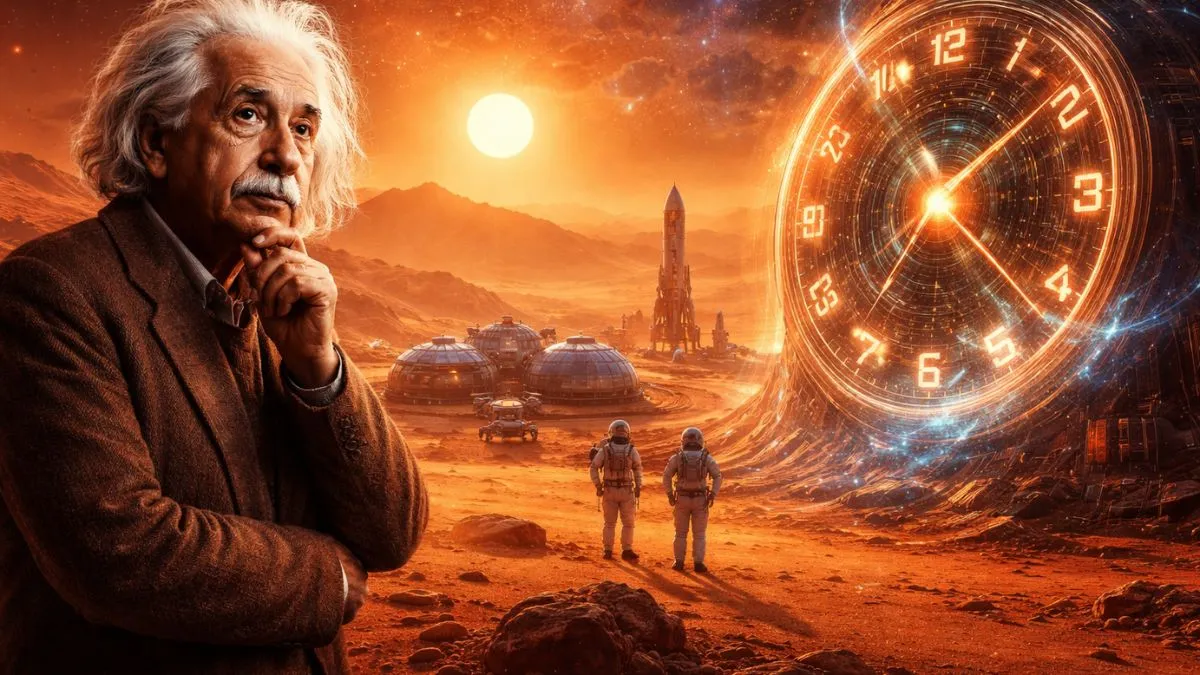
Albert Einstein Foresaw: The mission engineer paused mid-check.
On her screen in Pasadena, the time read 11:02:15. On the live telemetry stream from the Perseverance rover, the clock on Mars lagged behind — not dramatically, but unmistakably.
A fraction of a second.
Then another.
Then another.
She verified the synchronization system. Then the backup. Everything checked out. No hardware fault. No software error.
Only one variable had changed.
Mars itself.
Exactly as Albert Einstein predicted.
For agencies planning humanity’s first sustained presence on the Red Planet, this subtle discrepancy could redefine everything — from mission timelines to biological rhythms.
When Einstein’s equations collide with Martian dust
If you were standing on Mars, you wouldn’t sense anything unusual.
Your watch would tick normally.
Minutes would feel like minutes.
An hour would still feel like an hour.
Yet compared to Earth, your life would be drifting out of alignment — millisecond by millisecond. Your days would stretch slightly longer. Your heartbeat would age at a marginally different pace than loved ones back home.
Time — something we treat as universal — would quietly split into two versions.
Scientists have long known that a Martian sol lasts about 24 hours, 39 minutes, and 35 seconds, already enough to disrupt human sleep cycles. NASA teams operating rovers have lived this reality for years.
But recent ultra-precise measurements reveal something deeper: not just longer days, but a different rate of time itself.
Signals exchanged between Earth and Mars, atomic clocks aboard orbiters, and long-baseline radio tracking now align perfectly with Einstein’s theory. Mars’ weaker gravity and distinct orbital motion cause time to flow just slightly differently than on Earth.
It’s minuscule.
It’s continuous.
And it’s unavoidable.
Why Mars time isn’t a technical glitch — it’s fundamental physics
Einstein showed that time slows in stronger gravity and speeds up in weaker gravity. Motion also alters its pace. On Earth, this is already a practical concern — GPS satellites must apply relativistic corrections or navigation errors would grow by kilometers each day.
Now that same principle has expanded to interplanetary distances.
Mars has roughly one-third of Earth’s gravity and follows a different path around the Sun. Together, these factors subtly reshape local spacetime. A clock resting on Martian soil doesn’t merely mark longer days — its seconds gradually diverge from Earth seconds.
What once lived in physics textbooks is now appearing in real mission data.
Einstein wrote the equations.
Mars is validating them — grain by grain.
Designing missions for a planet where time refuses to behave
Future crewed missions won’t just carry food, oxygen, and fuel.
They’ll carry time.
Mission planners must now account for diverging planetary clocks when scheduling communication windows, orbital maneuvers, landings, and life-support cycles.
This is driving the push for a dedicated Mars time standard — not merely counting sols, but establishing a fully relativistically corrected system comparable to Earth’s UTC. Spacecraft clocks, astronaut watches, surface beacons, and habitats would all synchronize to Mars itself, not to Earth.
The rule becomes simple:
You don’t force Mars to match Earth.
You adapt to Mars.
NASA already has experience here. During rover missions, engineers worked on Mars time, shifting their schedules by about 40 minutes every Earth day. Many described it as constant jet lag. Some joked their social lives vanished entirely.
Now imagine sustaining that for years — or a lifetime.
Add signal delays of up to 20 minutes and drifting clocks, and precision becomes unforgiving. Thrusters firing a moment late or early could be catastrophic.
Mission timelines will soon exist in parallel: Earth time and Mars time, continuously translated by software correcting for relativity, orbital mechanics, and signal lag.
This isn’t academic. It’s the difference between a successful landing and a very expensive crater.
Everyday life under two clocks
For astronauts, the most practical solution is also the most human: live by Mars time and let machines handle the complexity.
Future watches, tablets, and control panels will likely display Mars hours and sols as the primary reference, with Earth time shown secondarily. Calendars will automatically compensate for relativistic drift and communication delays.
Think of it as a dual-time-zone system — except the difference isn’t geography. It’s physics.
Your workout might begin at 07:15 Mars Standard Time, while Earth lingers in yesterday afternoon. Video calls would be scheduled by software fluent in both planetary clocks.
The goal is clear: let humans live normally, while computers wrestle with Einstein.
But there’s also an emotional cost. Living on another planet means existing in a rhythm that never quite matches home. Birthdays might arrive minutes “late.” Calls might always feel slightly off. Over time, that subtle misalignment could weigh heavily.
Ignoring this as mere math would be a mistake. Routine, shared rituals, and consistent schedules will be just as vital as precise equations.
When time itself becomes cultural?
Accept that time is local, and something remarkable happens.
Children born on Mars will age in Martian years and sols. Their birthdays won’t align neatly with Earth calendars. Grandparents may argue over which date is the “real” one — Earth time or Mars time.
This isn’t science fiction flair. It’s the beginning of a cultural divergence rooted in physics, not politics.
Workweeks, holidays, and school schedules on Mars will evolve around its slower tempo. Over generations, Earth time may feel as distant as an ancient calendar system.
One planet, one rhythm.
Another planet, another beat.
Between them, radio waves translate not just words — but seconds.
Key insights at a glance
| Key Point | What It Means | Why It Matters |
|---|---|---|
| Einstein’s time dilation | Mars’ gravity and motion alter the flow of time | Explains why time stops being universal beyond Earth |
| Mars-specific time standard | A dedicated, relativistically corrected Mars time | Shows how missions and colonies will organize daily life |
| Human impact | Calls, routines, and aging feel slightly out of sync | Highlights the emotional reality of interplanetary living |
Mars and the End of Universal Time
Mars is teaching humanity a quiet but profound lesson: time is not absolute. As we prepare to step onto another world, we’re discovering that exploration isn’t just about distance — it’s about adapting to entirely new temporal realities.
Future missions and settlements will succeed not by forcing Earth’s clock onto Mars, but by embracing the planet’s own rhythm. In doing so, we move closer to becoming a truly multi-planet species — one that lives not under a single universal clock, but across many local versions of time itself.
FAQs
Is time actually slower on Mars than on Earth?
Yes, by a very small amount. Mars’ weaker gravity and different motion cause clocks there to tick at a slightly different rate than on Earth.
Would a person feel time moving differently on Mars?
No. Locally, time feels completely normal. The difference only appears when comparing precise clocks between planets.
Is this just about longer Martian days?
No. The longer sol is one factor, but relativity also affects the fundamental pace of time itself.